
It takes place in the production facilities of the company `` SATO“ in Kraljevo, with its own funds, with modern equipment and with the application of the most modern technical and technological solutions in the machine industry. Our production program is based on the manufacture of metal machine parts with very strict tolerances, the manufacture of assemblies and complete devices. In addition to our own products, we also make products at the customer’s request with the appropriate technical documentation, which are not given in the catalog of our products. All our products, machine parts, assemblies and complete devices meet the strict criteria and standards of ISO 9001.
What is laser metal cutting?
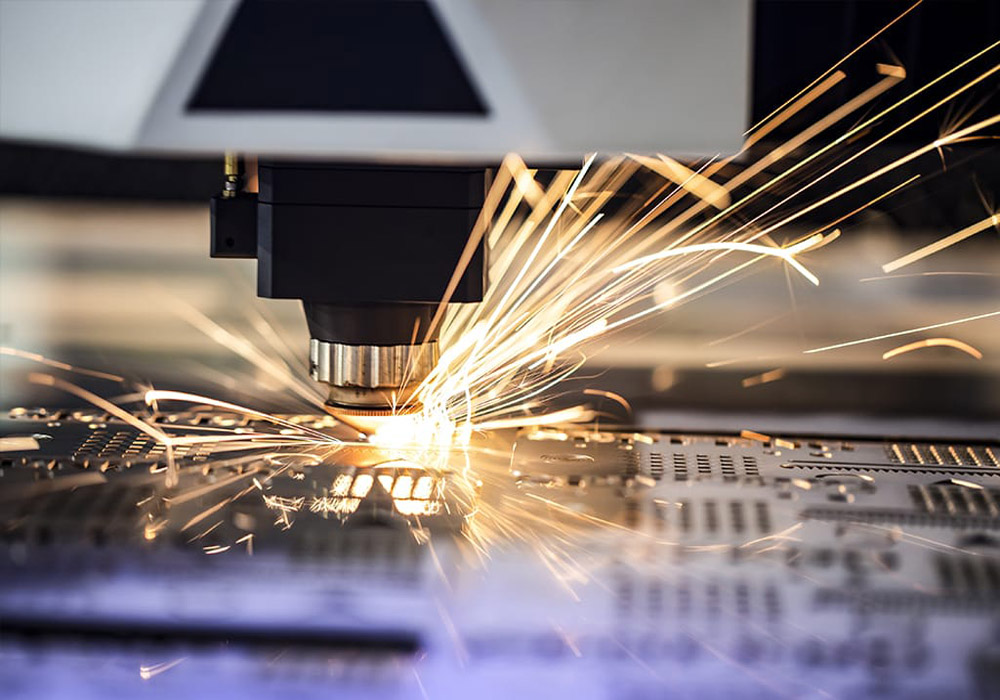
Laser metal cutting is a technology that uses high-intensity laser beams that cut materials in synergy with inert gas. This type of metal cutting works by directing a high-power laser directly onto the metal through the optics. Laser optics, together with computer numerical control - CNC (computer numerical control) is used to direct the generated laser beam. The focused laser beam is directed at the metal, which then melts, burns, evaporates or is blown away by a jet of compressed air, leaving an edge with high-quality surface treatment. In addition to sheets, pipes and profiles can also be laser cut.
Laser cutting process.
In order for the laser cutting process to be efficient and economical, it is necessary to adjust the laser parameters before cutting. Most lasers used in industrial production are powered by CNC technology, so the adjustment process itself requires knowledge of computer control, knowledge of laser cutting technology and good knowledge of the composition of markings and properties of materials that are cut by laser beam. Laser (light amplification by stimulated emission of radiation) uses infrared laser beam to cut a wide range of materials. A laser beam is a beam of high frequency energy that is focused on a single point on the metal being cut. By directing the laser beam at a small area of metal, the surface is heated to the point where melting begins and gases are used to remove the molten material. Focusing the laser beam is possible with the help of special mirrors or optical fibers that are located in the head of the laser cutter and serve to direct light on the lens that focuses the laser beam on the work surface. At the beginning of the cutting, on CO2 lasers the beam travels from the laser resonator and is directed by mirrors towards the nozzles, while in fiber lasers the beam is transmitted by an optical cable. After passing through the nozzle, the laser beam hits the metal being cut and after a very short time interval penetrates through it, thus starting the process of laser cutting. During laser cutting, the laser head moves above the material being cut at a certain distance. The speed but also the quality of the cut depends on this distance of the laser head. In order to be able to start cutting from a place other than the edge, drilling is done before each cut. Drilling usually involves a high-power pulsed laser beam that slowly makes a hole in the material, and the process itself can take a fraction of a second or a few seconds depending on the thickness of the metal.
Laser metal cutting characteristics.
Different types of gases are used in laser cutting. Gases can be oxygen and nitrogen. Gas is selected based on the type of material being cut. The laser beam melts the metal being cut and the gas has the task of removing the molten metal from the surface with its flow in order to make the cut as high quality as possible. The laser cutting process itself has several parameters that are variable. One of them is whether the laser beam will be pulsed or continuous. The power of the laser beam determines the penetration. Impulse beam is used for precise cutting. Continuous beam is used when it comes to smoother and thicker materials.
What types of metals can a laser cut?
Laser is used to cut various types of metals. For some types of metals such as stainless steel, this is the most economical type of cutting. • steel • stainless steel • aluminum • copper • brass
Basic advantages of laser cutting.
High speed of technology development has led us to the fact that today this is one of the most economical, most efficient and fastest methods for cutting metal. The main advantages of this type of metal cutting in relation to mechanical cutting are: 1. High level of cutting precision - CNC laser cutting allows us to obtain shiny and smooth, precise edges, therefore no additional metal processing is required. The precision of laser cutting lies in the fact that the laser beam does not wear out over time. (The fiber laser we have provides us with an accuracy of as much as ± 0.02 mm.) 2. High cutting speed - Thanks to laser technology, we can cut the desired shapes much faster compared to traditional cutting methods. (Fiber laser we have allows us to achieve cutting speeds of up to 300mm / sec.) 3. Low level of deformation of the material - There is little chance that the metal to be cut will be deformed, distorted or damaged, because laser systems focus on a small area of metal which is then under the influence of heat. 4. Possibility of obtaining irregular external and internal shapes - The main advantages of laser cutting in relation to mechanical cutting are easier control and manipulation of the cutting object. This allows us to obtain the desired regular or irregular shapes on the metal. In addition, the contamination of the material itself is significantly reduced (because there is no cutting edge), ie there is no direct contact between the laser and the material being cut. Some materials are also very difficult or impossible to cut in traditional ways, while the laser does it non-contact easily. 5. Low level of environmental pollution - the laser uses less energy during the cutting process, and also does not pollute the environment. Operator safety has been raised to a higher level. Application of laser cutting
Primena laserskog rezanja.
Today's modern cutting lasers use CNC control or are a kind of robot. With the advancement of cutting technology and thanks to the high precision of lasers, laser cutting of metals is being used in many branches of industry. Laser cutting is a great way to produce prototypes, but also serial production for a large number of products. • Production and processing • Metallurgy • Construction • Electronics • Architecture • Shipbuilding • Mining • Automotive industry • Agricultural machinery • Aviation
Contact
+38164 929 19 99